Foundation Systems & Turn-Based Architecture
This first development milestone establishes the foundational architecture for Battle Arena’s autonomous agent playground. The focus was on building robust core systems that will support future AI training workflows and agent development. Key achievements include implementing a complete turn-based mechanics framework, hex grid navigation controller, session state management, and comprehensive I/O handling. All agent animations are now integrated and functional, UI feedback systems are operational, and the project has CI/CD pipelines configured for automated builds.
Major Systems Delivered:
- Turn-based gameplay mechanics replacing real-time systems
- Hexagonal grid pathfinding and navigation controller
- Session state management with global signal architecture
- Complete animation state machine (8 animation states)
- Input/output controller with hotkey support
- UI overlay with visual feedback for targeting and selection
- Debug tooling and overlay systems
- GitHub Actions CI/CD pipeline
Detailed Updates
Epic: Pathfinding Navigation (RGZ-33)
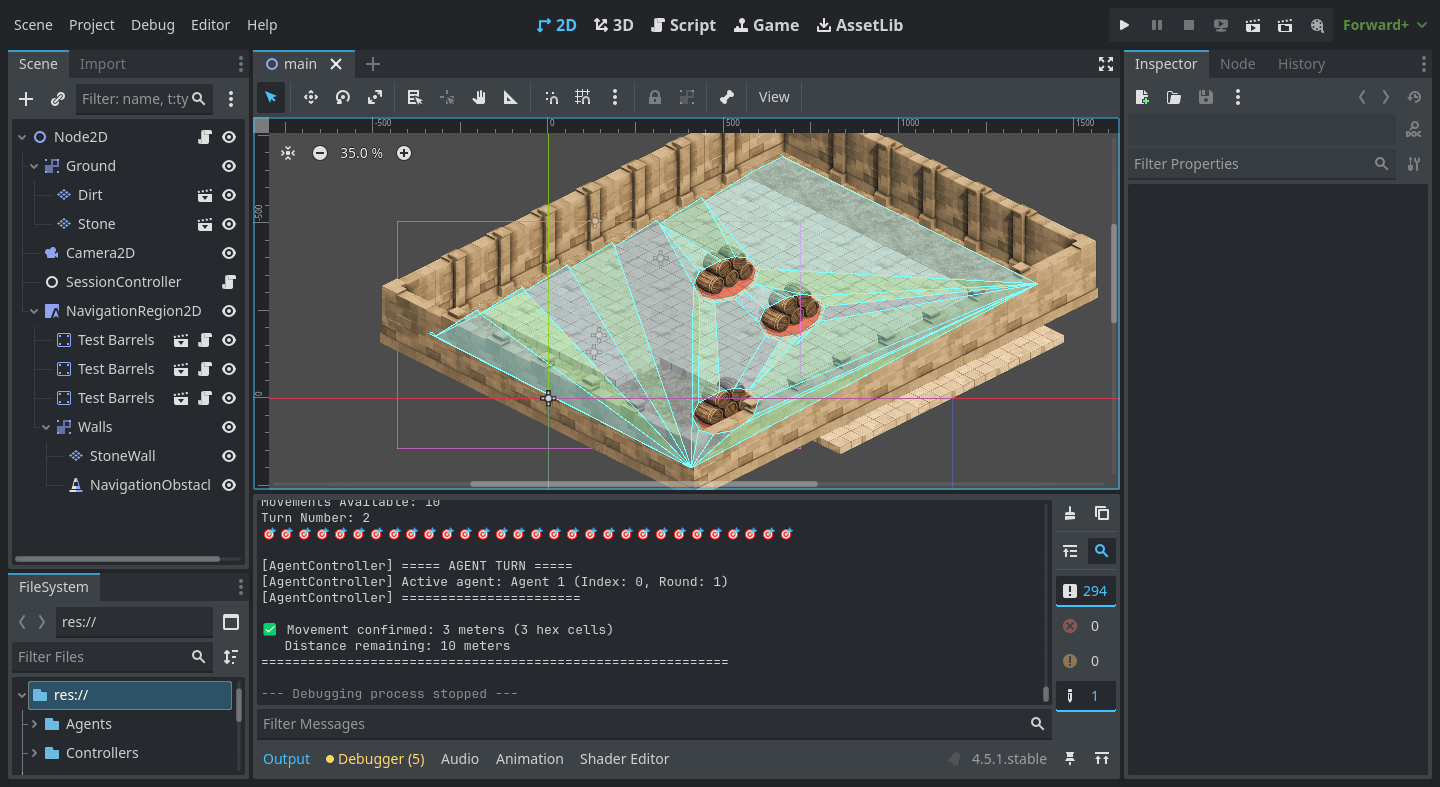
The pathfinding system received a complete overhaul to support the game’s shift to turn-based mechanics. The new architecture separates pathfinding logic from movement execution, enabling agents to calculate optimal paths through the hex grid while respecting turn-based constraints.
Key Features:
- A* pathfinding algorithm implementation for hex grid traversal
- Turn-based movement queue system
- Path visualization and debug feedback
- Integration with hex grid controller for coordinate translation
Technical Implementation:
- Modular pathfinding component that can be attached to any agent
- Signal-based communication between pathfinding and movement systems
- Support for both player-controlled and autonomous agent pathfinding
Story Completed: Debug & UI feedback (RGZ-39) - Visual indicators now show calculated paths, movement range, and navigation constraints in real-time.
Epic: Hex Grid Controller (RGZ-48)
Built a comprehensive hexagonal grid management system that serves as the spatial foundation for all agent interactions and movement. This system handles coordinate conversions, tile state management, and provides the data structures needed for pathfinding and strategic positioning.
Architecture:
- Axial coordinate system for hex grid representation
- Y-sorting and z-index management for proper visual layering
- Isolated, atomized feature design for modularity
Stories Completed:
- Y Sorting & Z Index for UI Overlay (RGZ-49): Ensures UI elements and agents render in correct visual order based on position
- Atomize feature so it is isolated (RGZ-50): Refactored hex grid logic into standalone module that can be reused and tested independently
This controller is critical for the AI training pipeline, as it provides the discrete state space that agents will navigate during learning.
Epic: Session Controller (RGZ-35)
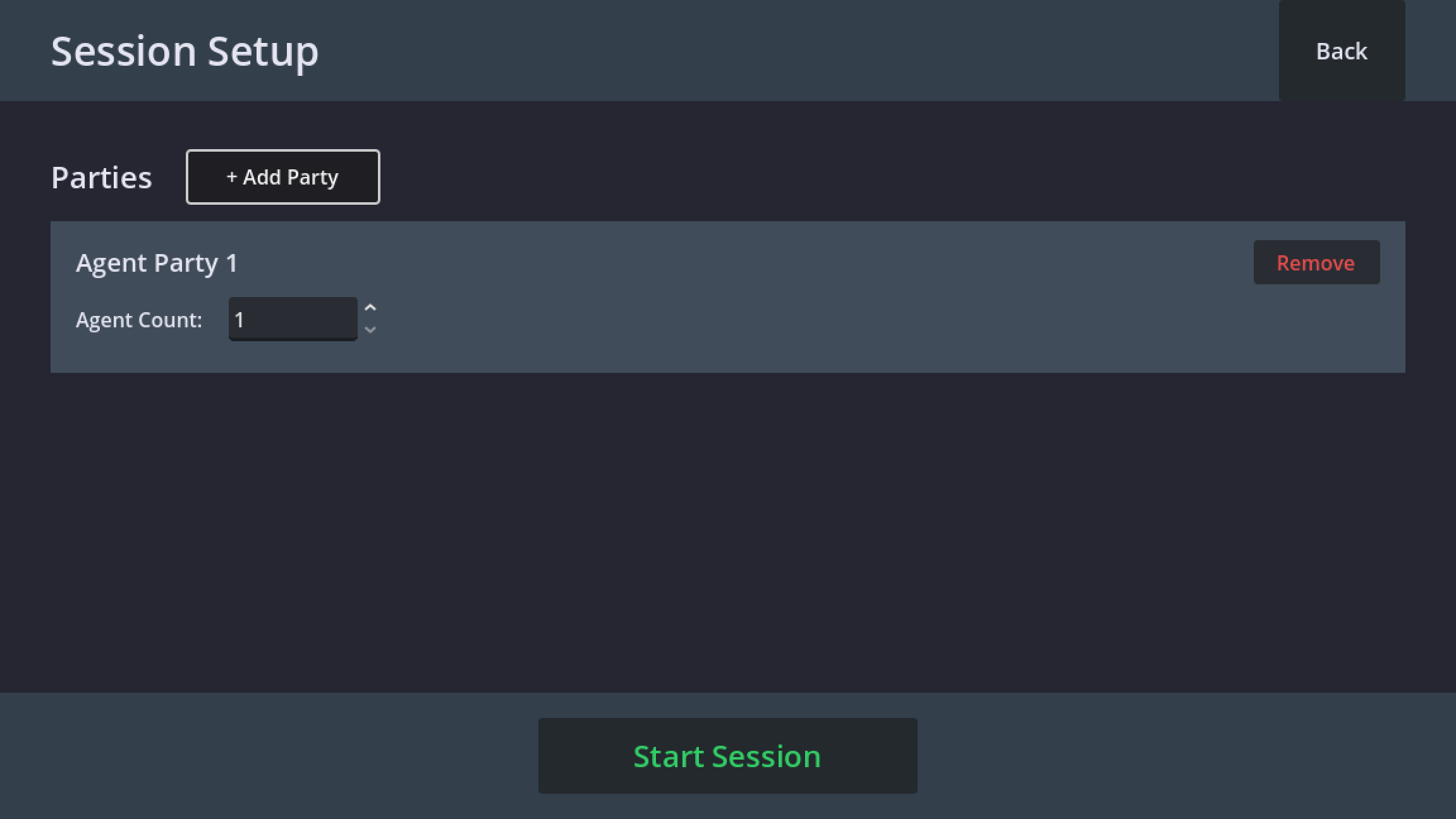
Implemented a centralized session management system that orchestrates game state, turn progression, and inter-component communication. This controller acts as the “brain” coordinating all subsystems.
Core Functionality:
- Global signal architecture for event-driven communication
- Turn state management and progression logic
- Agent registration and lifecycle tracking
- Session-level data collection hooks for training pipelines
Stories Completed:
- Create Session Controller Signals (RGZ-67): Event-driven communication between game systems
- Create Global State Management (RGZ-68): Centralized state tracking for debugging and data logging
This architecture is essential for data collection during agent training sessions, as it provides hooks to capture state transitions, action sequences, and outcomes.
Epic: Transition to Turn-Based Mechanics (RGZ-38)
Completely restructured the game’s core mechanics from real-time to turn-based systems. This fundamental architectural shift enables discrete action spaces that are essential for reinforcement learning and provides clear state boundaries for data collection.
Changes:
- Converted all agent actions to discrete turn-based operations
- Implemented action point system for movement and combat
- Created turn queue and priority system
- Synchronized animation playback with turn-based actions
Impact on AI Development: This change transforms the environment into a proper Markov Decision Process (MDP), making it suitable for standard RL algorithms. Discrete turns provide clean episode boundaries and make reward assignment straightforward.
Animation System Implementation
All agent animation states are now fully integrated with the turn-based mechanics system. The animation controller responds to game events and smoothly transitions between states based on agent actions.
Animations Completed (RGZ-87 through RGZ-94):
- Idle - Default standing state
- Walk - Standard movement animation
- Run - Fast movement animation
- Jump - Vertical movement/obstacle clearing
- Fire - Ranged attack animation
- IdleAim - Aiming while stationary
- WalkFire - Moving while shooting
- RunJump - Combined run and jump for dynamic movement
Technical Details:
- State machine architecture for animation transitions
- Synchronized with turn-based action execution
- Designed to provide visual feedback for agent decision-making during training
Epic: Menu & UI (RGZ-34)
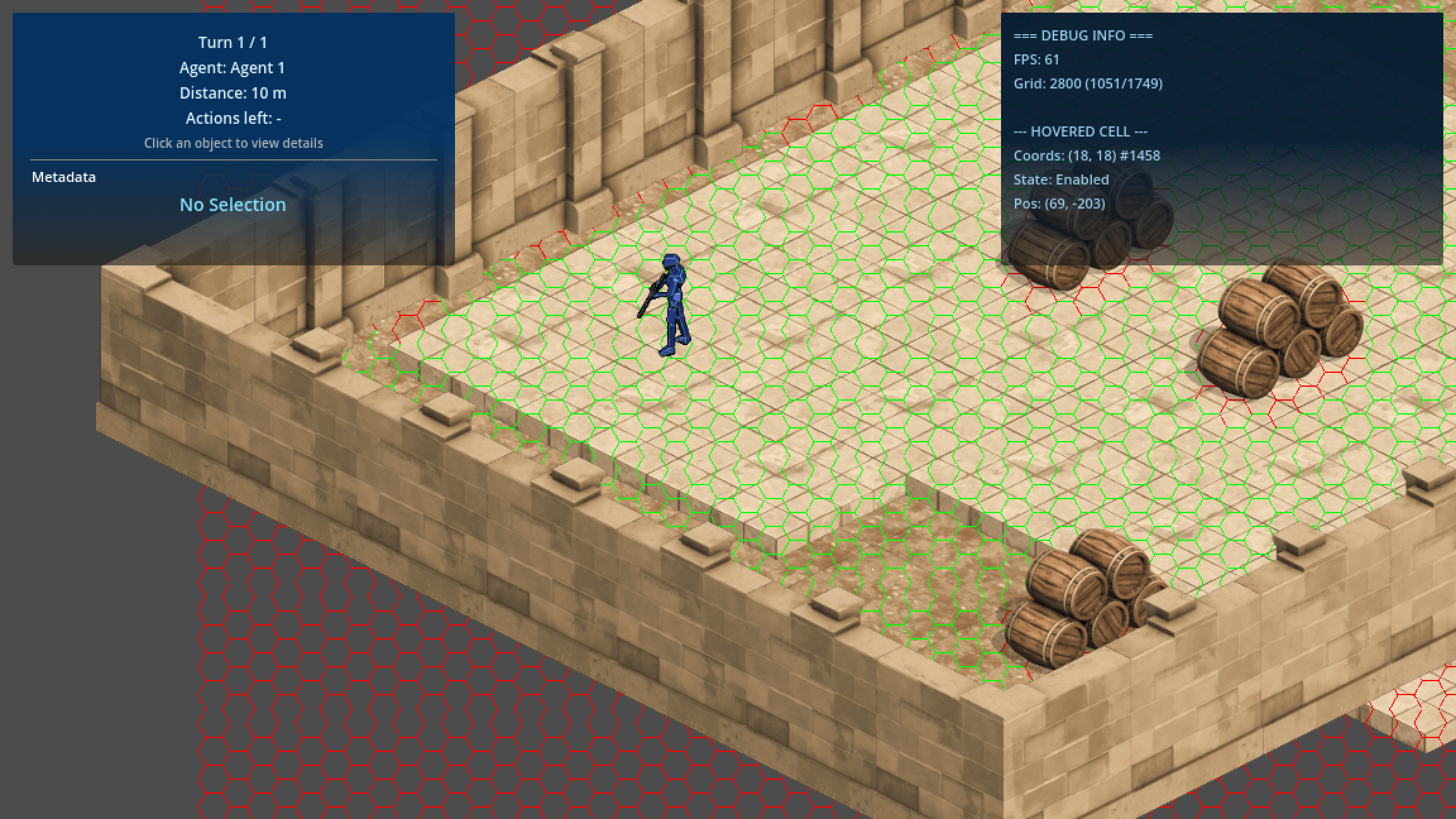
Created comprehensive user interface systems for player interaction and visual feedback. The UI supports both manual control (for generating supervised learning data) and observation of autonomous agent behavior.
Stories Completed:
- Create UI Overlay (RGZ-53): Information displays for agent stats, turn state, and system status
- Create feedback from target selection and interaction (RGZ-54): Visual indicators for targeting, selection, and valid actions
- Create Debug Overlay (RGZ-70): Developer tools for monitoring system state and agent behavior
The UI is designed to be non-intrusive during autonomous agent training while providing rich feedback during manual control sessions.
Epic: I/O Controller (RGZ-37)
Built a flexible input handling system that supports both player control and programmatic agent control. This dual-mode design is critical for the hybrid training approach.
Features:
- Enable click targeting (RGZ-63): Mouse-based agent selection and command issuance
- Create Hotkeys (RGZ-64): Keyboard shortcuts for common actions and debug commands
Architecture:
- Abstracted input layer that can be driven by either human input or AI agent output
- Event-based command system for action execution
- Input recording capability for supervised learning data collection
Infrastructure & DevOps
GitHub CI/CD Pipeline (RGZ-142):
Configured automated build and test workflows using godot-ci actions. This enables continuous integration for the project and automated artifact generation.
Bug Fixes:
- Resolved import errors from pull request merge conflicts (RGZ-133)
- Fixed asset path references in production builds
Technical Notes
Performance Considerations: The turn-based architecture significantly simplifies state management and makes the system more predictable for AI training. Discrete actions and clear state boundaries reduce the complexity of training loops.
Data Collection Readiness: All major systems now include logging hooks and event emission. The next phase will involve connecting these hooks to data serialization pipelines for training data generation.
Modularity: Each epic represents an isolated subsystem with minimal coupling. This design enables parallel development of different agent architectures and easy swapping of components for experimentation.
What’s Next
The foundation is now in place for the next phase of development:
- Agent Controller Implementation - Building the decision-making layer that will interface with ML models
- Data Logging Pipeline - Structured data collection for training dataset generation
- Baseline RL Training Loop - Initial reinforcement learning implementation using collected data
- Combat System Refinement - Expanding combat mechanics to create richer state spaces
- Multi-Agent Scenarios - Testing with multiple simultaneous autonomous agents
This milestone represents the transition from infrastructure development to actual AI agent implementation and training experimentation.
Total Items Completed: 26 (5 Epics, 13 Stories, 8 Subtasks)
Development Period: November 25-29, 2025
Lines Changed: See PR #8