Architecture Refactoring & Visual Feedback Systems
Commit Range: eebeec1 → 73c68d8
Date: November 30 - December 2, 2025
Focus: Modular architecture and player experience enhancements
This development sprint delivered foundational improvements to the Battle Arena platform, focusing on architectural refactoring and visual feedback systems. The work centered on two major epics: a complete navigation system rewrite that establishes modular, maintainable code patterns, and a hex cell visual feedback system that provides immediate player guidance about valid movement options. Supporting these core features, infrastructure improvements including automated code review, CI/CD workflows, and project governance establish a more mature development environment.
Epic 1: Navigation System Rewrite (RGZ-147)
The Challenge
The previous navigation system suffered from monolithic design patterns that mixed concerns across pathfinding algorithms, movement execution, and state management. This architecture made debugging difficult, complicated AI agent integration, and limited extensibility for supporting both real-time and turn-based navigation modes. The codebase needed a fundamental restructure to support the platform’s long-term goals as an autonomous agent training environment.
Modular Package Architecture
Commit: eebeec1
Impact: 54 files changed (+3,304 lines, -1,217 lines)
The rewrite establishes three distinct packages that separate concerns and provide clear boundaries:
- Pathfinding Package: Pure pathfinding logic isolated from movement execution
- RealTimeNavigation Package: Continuous navigation for real-time agent control
- TurnBasedNavigation Package: Discrete movement system for turn-based gameplay
Core Algorithm Components
The new architecture breaks pathfinding into focused, single-responsibility modules:
Algorithm Layer:
astar_pathfinder.gd- Pure A* implementation using priority queueheuristics.gd- Distance strategies (Manhattan, Euclidean, Chebyshev)path_reconstructor.gd- Reconstructs complete paths from pathfinding resultspath_validator.gd- Validates paths before execution
Movement System:
movement_executor.gd- Coordinates movement operationsmovement_physics.gd- Physics-based movement calculationswaypoint_tracker.gd- Tracks progress along paths with stuck detectionprogress_tracker.gd- Monitors movement completion status
State Management:
navigation_state.gd- Centralized state containerrequest_manager.gd- Queues and prioritizes navigation requeststurn_state_machine.gd- State machine for turn-based control flow
Utilities & Configuration:
movement_constants.gd- Centralized configuration (speeds, tolerances, physics parameters)navigation_types.gd- Type definitions and enumsdirection_utils.gd- Directional calculations for animation integrationdistance_calculator.gd- Unit conversion and distance measurementinterpolation_utils.gd- Smooth movement interpolation
Technical Highlights
The refactor removed monolithic controllers that had grown unwieldy:
- Old
hex_agent_navigator.gd(208 lines) → Replaced with modular navigator - Old
nav_agent_2d_follower.gd(74 lines) → Replaced with follower system - Old
turn_based_movement_controller.gd(507 lines) → Replaced with state machine approach
The agent_controller.gd received a new start_agent_turn() method enabling manual turn initialization, providing precise control over turn-based flow for AI training scenarios.
Impact on Development
This architectural foundation delivers immediate and long-term benefits:
- Debugging: Isolated components simplify identifying and fixing issues
- AI Integration: Clear interfaces reduce complexity for agent implementations
- Pathfinding Extensions: Adding new algorithms (Dijkstra, Jump Point Search) requires minimal changes
- Testing: Single-responsibility modules enable focused unit testing
- Performance: Optimization efforts can target specific bottlenecks
Epic 2: Hex Cell Visual Feedback System (RGZ-140, RGZ-148)
The Challenge
Players needed immediate visual feedback about which cells they could move to, but the codebase lacked a cohesive system for displaying movement constraints. Debug visualization and gameplay feedback were entangled, and there was no visual indication distinguishing navigable cells from those outside the agent’s movement range.
Evolution Across Three Commits
Commit 062dadb: Initial Implementation
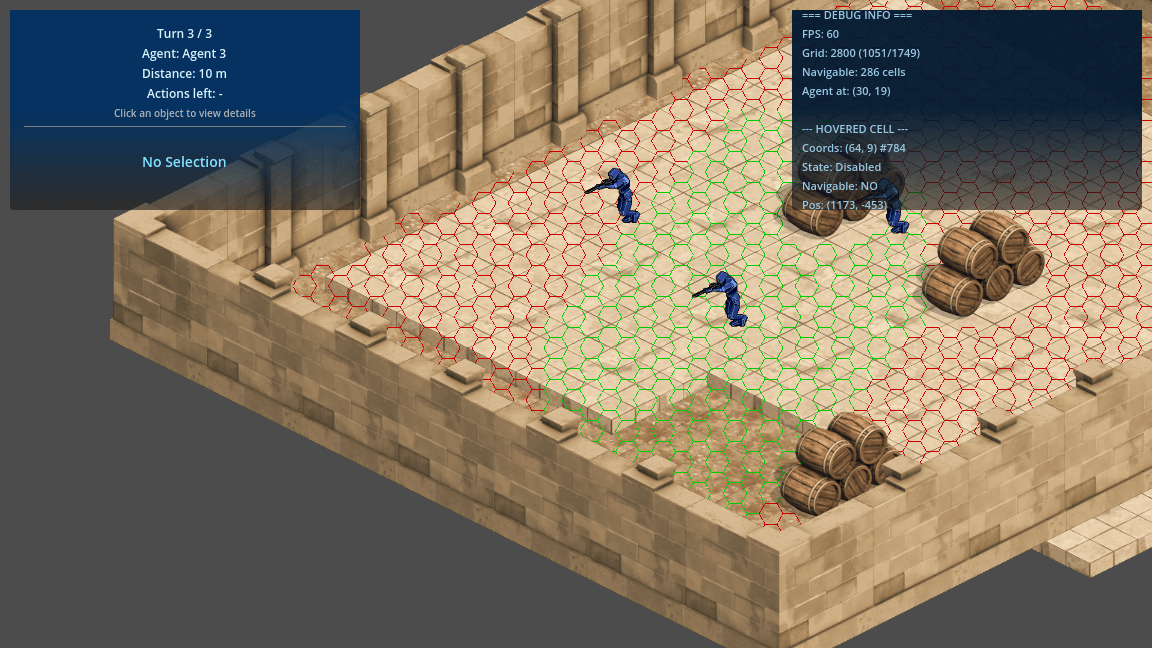
The foundation introduced hex_cell_hover_visualizer.gd, a component that renders color-coded hex outlines:
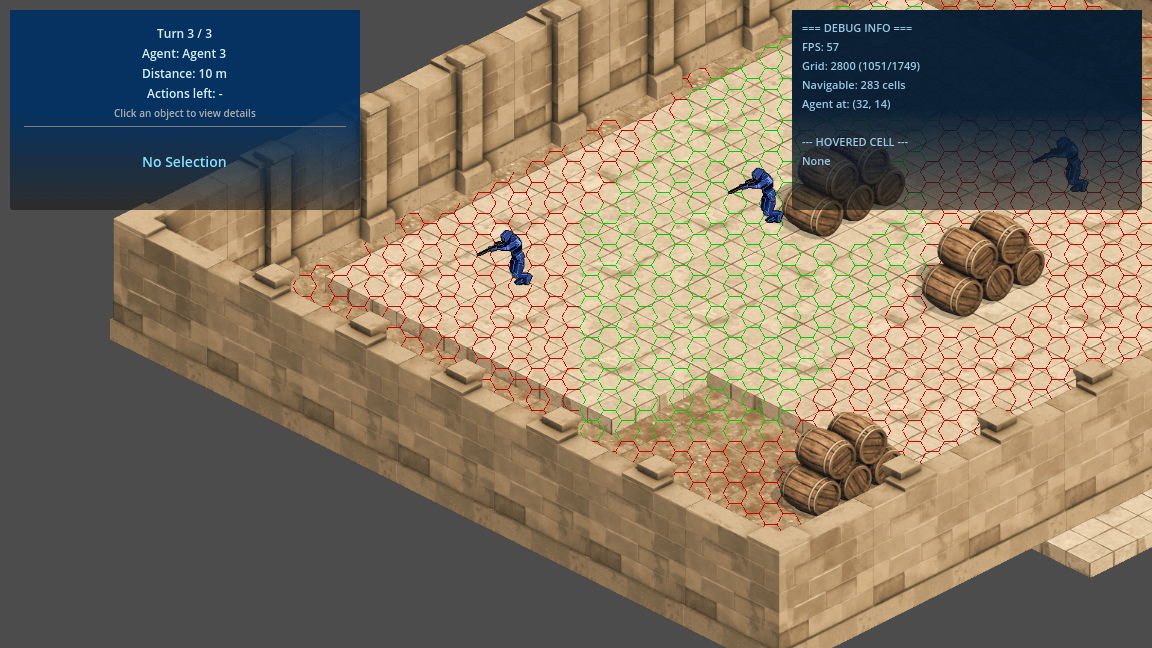
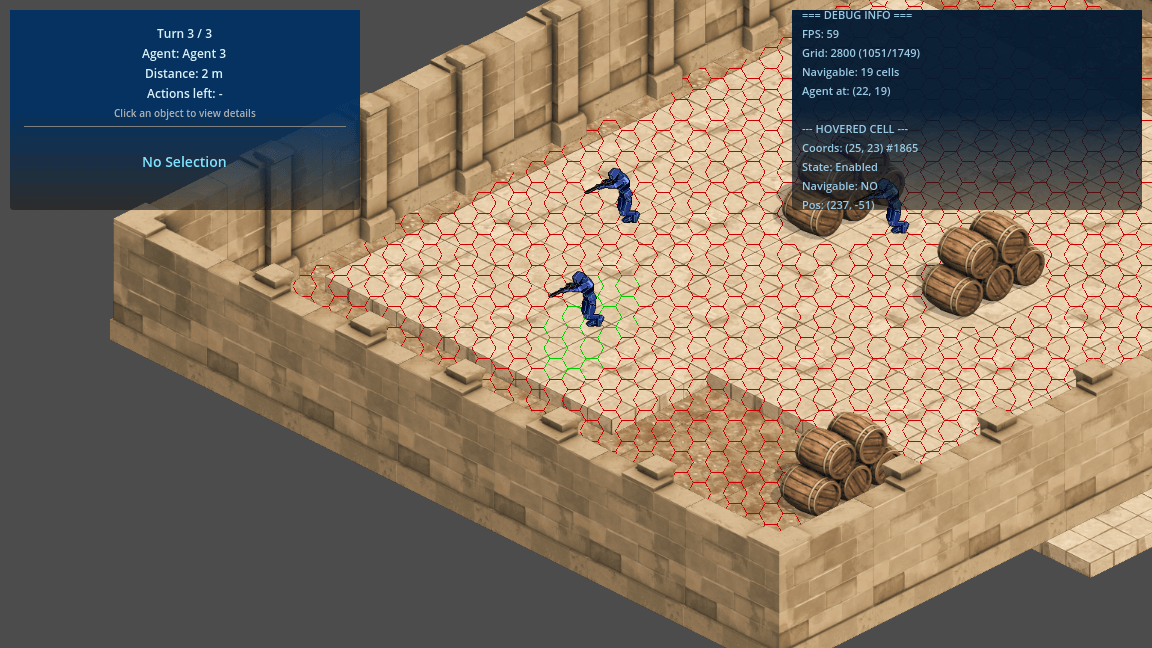
- Green outlines indicate navigable cells (within movement range)
- Red outlines indicate non-navigable cells (outside range)
- No outline for disabled cells
A Z-index layering system separates debug visualization (Z: -1) from gameplay feedback (Z: 5) and selection highlighting (Z: 10), preventing visual clutter while maintaining debug capabilities.
Commit c9d31c1: RGZ-148 Major Refactoring
This commit delivered the intelligence behind visual feedback through a navigable cells tracking system integrated into session_controller.gd:
New Functionality:
navigable_cells_updatedsignal broadcasts reachable cells at turn start- Pathfinding-based reachability calculation (not just radial distance)
- Movement budget constraint respect (
max_movements_per_turn) - Enhanced
HexGridDebugto visualize entire navigable set
The session controller cleanup removed 1,480 lines while adding 1,127 new lines, significantly improving maintainability.
Commit d1de84d: RGZ-140 Code Quality Pass
Final polish focused on code formatting:
- Comment alignment standardization in enums
- Whitespace normalization across navigation files
- Operator spacing consistency
Key Features
1. Dual-Mode Visualization
The system provides context-appropriate feedback:
- Normal Mode: Hover-based single-cell feedback shows navigability as cursor moves
- Debug Mode: Grid-wide highlighting displays all navigable cells simultaneously
The modes toggle inversely—when debug mode activates, hover visualization deactivates, preventing UI clutter while maintaining the information density developers need.
2. Intelligent Range Calculation
Unlike simple radial distance checks, the system uses actual pathfinding to determine which cells are reachable:
- Accounts for obstacles and disabled cells blocking paths
- Respects terrain costs and movement constraints
- Updates dynamically when turns start or agent movement budget changes
3. API Enhancements
New public methods on SessionController enable other systems to query navigability:
func is_cell_navigable(cell: HexCell) -> bool
func get_navigable_cells() -> Array[HexCell]
func update_navigable_cells(agent = null) -> void
Technical Implementation
Hexagon Rendering: The visualizer generates flat-top hexagons by calculating six points at 60-degree intervals, then draws lines connecting vertices with configurable outline width.
Signal-Based Architecture: Zero tight coupling between visualizers and controllers. Components communicate exclusively through signals, enabling independent testing and future refactoring.
Configuration: Export variables expose colors, outline widths, and hex sizes, allowing designers to tune feedback without code changes.
Impact on Player Experience
- Immediate Feedback: Players instantly understand movement options without trial-and-error
- Cognitive Load Reduction: Visual color coding (green = valid, red = invalid) eliminates mental calculation
- Professional Polish: Clean visual feedback communicates system reliability
- Preserved Debug Tools: Debug mode remains fully functional for development work
Infrastructure & Code Quality
CodeRabbit Integration
Automated code review now guards pull requests:
- Schema v2 compliance for modern PR review workflows
- Jira integration links commits to issue tracking
- Iterative refinement across multiple commits improved precision (float-based distance calculations)
CI/CD Workflow
GitHub Actions now automates build and export:
- Godot CI/CD pipeline configured for continuous integration
- Cross-platform export targeting (macOS, Android)
- Texture compression optimization for platform-specific constraints
- Ongoing debugging of platform export edge cases
Project Governance
Open-source foundations established:
- GNU General Public License v3 clarifies usage rights
- README documentation improves contributor onboarding
- snake_case naming convention enforced for consistency
- Repository structure standardization aids navigation
Impact on Development Velocity
These infrastructure improvements compound over time:
- Code quality gates catch issues before merge
- Automated builds eliminate manual export workflows
- Clear licensing removes legal uncertainty for contributors
- Documentation reduces onboarding friction
What’s Next
Short-term priorities continue building on this foundation:
- CI/CD Refinement: Debug remaining platform export edge cases
- Enhanced Selection Feedback: Expand hex cell visual systems to show attack ranges and ability targeting
- AI Training Scenarios: Leverage navigation architecture to implement training environments
- Grid Performance: Optimize for larger battlefields (current focus: 32x32, target: 64x64+)
- Debug Tooling: Add navigation path visualization and performance profiling overlays
Development Metrics
- Commits: ~40 commits across integration branches
- Date Range: November 30 - December 2, 2025
- Lines Changed: ~4,500 additions, ~2,700 deletions
- Primary Focus: Architectural foundation and player experience
- Key Stories: RGZ-147 (Navigation Rewrite), RGZ-140 (Hex Outlining), RGZ-148 (Hex Highlighting)
Every change in this sprint serves the platform’s core mission: creating a robust, maintainable environment for training autonomous agents in turn-based tactical gameplay. The modular navigation architecture establishes patterns that will scale as gameplay complexity grows, while visual feedback systems reduce the learning curve for both human players and AI agents. Infrastructure maturity ensures the project can welcome open-source contributors and maintain quality standards as development accelerates.